Sunday, 8 May 2016

Let’s Talk About Mental Health...


John is 28 years old. His friends and family have given him nicknames such as “All-Over-the-Place, John”, “Psycho John”, “Hurricane John”, “Attention-Seeking-John”, and “Sad-Sam-John”, among others.  Some of John’s loved ones describe him as being the life of the party, constantly laughing, and always ready to help. Others say he lacks boundaries, is short-tempered, rude, immature, impulsive, self-centered, and unbearable.

John is one of the “lucky” ones. Two of his childhood friends realized there was more to his behavior than attention-seeking and being difficult. John has a mental illness and got the help and support that he needed in time.

Fact 1: According to the National Institute of Mental Health (NIMH), 57.7 million people (ages 18 and older) in America experience mental illness each year.1
Many of us believe that mental illness doesn’t affect us and as such, we remain ill-informed. Statistics show that at some point in our lives, many of us will interact with people who suffer from a mental illness. According to the U.S. Department of Health and Human Services (DHHS):
a)      1 in 5 adults in America experienced a diagnosable mental disorder (2014);2
b)      At least 1 in 10 young people suffered from major depression (2014);3
c)      Half of all chronic mental illnesses show first signs in individuals as young as 14, with three quarters of mental health disorders beginning before the age of 24;4 and
d)      1 in 25 Americans live with a serious mental illness (major depression, schizophrenia, or bipolar disorder).5


Fact 2: Many individuals who suffer from mental illness do not receive the medical and emotional help they need. 
Due to the stigma and pre-conceived notions surrounding mental illness, many who suffer from it are rejected, abused, and discriminated against. As a result, they do not get the help that they need.  Those who do get help often end up in institutions that resemble human warehouses, as opposed to comforting environments that offer healing.6 The National Alliance on Mental Illness (NAMI) states that in America:
a)      60% of adults and 50% of youth between the ages of 8 and 15, with a mental illness, did not receive mental health services in the previous year.7
b)      90% of those who commit suicide have a history of mental illness.8


Fact 3: People with mental illness did not get this illness because they are weak, immature, self-centered, or stubborn.

Mental illness affects each person differently. Until a person is diagnosed with a mental illness, it is very easy to misunderstand or dismiss their behavior. According to the US DHHS:
a)      Genes, illness, trauma, and family history are some of the factors that contribute to mental illness;9
b)      People with mental illness can’t just overcome their illness with willpower—they genuinely require treatment, mental health services, and community support to get better;10
c)      People with mental health problems can get better and some recover completely.11


Fact 4: Just because someone is mentally ill does not mean they are unpredictable and prone to violence.
With all the devastating cases of mass killings, many people assume that those who suffer from a mental illness are capable of committing an act of violence towards others or themselves.

The World Health Organization (WHO) states that “mental disorders are important risk factors for other diseases, as well as unintentional and intentional injury” (2014).12 The US DHHS states that:
a)      Only 3%-5% of those living with a serious mental health issue have committed violent acts.13
b)      Those living with a serious mental health illness are 10% more likely to be victims, rather than perpetrators, of violent acts.14
c)      We likely each know a friend, family member, or colleague with a mental illness and do not realize they have it, because they are productive, active members of society living full lives.15


Fact 5: A person living with a mental illness is capable of obtaining and keeping employment.
Some mental illnesses are severe enough to disrupt daily life, making it hard and sometimes impossible for an individual to get and hold down a job. As such, many people assume that all those with mental health needs are unable to perform as well as their colleagues, or even keep their jobs. The US DHHS states that:
a)      Many people with mental health needs, who are receiving help for their illness, have good attendance, are motivated, and perform equally (or better) than their colleagues.16
b)      Identifying and treating mental illness in good time has great benefits, such as fewer reports of absenteeism, lower medical costs, more productivity, and lower disability costs.17


What can you do?
1)      Learn about the different types of mental illness. This knowledge could help you identify the common warning signs18 and better support someone you know with a mental illness.
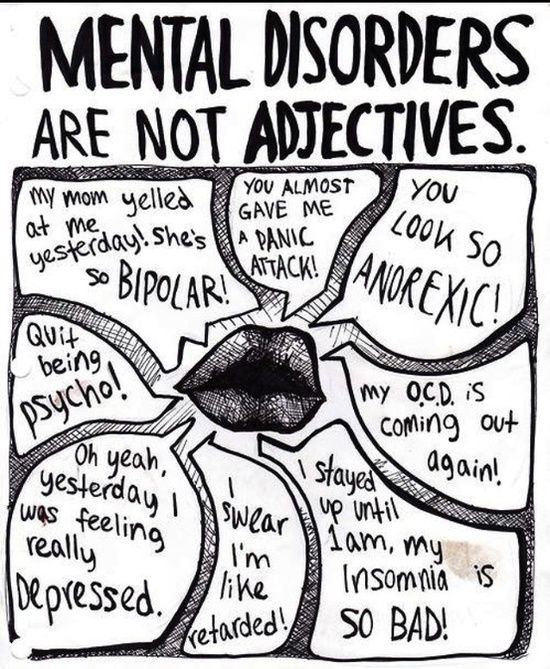
2)      If you think someone you know might have a mental illness, seek professional advice. Putting labels on mentally ill individuals or making jokes about mental illness is harmful, disrespectful, and unkind.
3)      Start having conversations about mental health and illness. By acknowledging its existence and impact on society, we are taking steps to better understand and manage mental illness, while being supportive of those who suffer from it.
4)      One size does not fit all when it comes to treating mental illness. Do not discourage loved ones from pursuing various forms of treatment and support. Medication alone will not work in all cases. Many patients also need therapy, other forms of self-help, and community support to get better.
5)      Be as supportive as you can. It’s certainly not easy dealing with a loved one with a mental illness. But those with mental illness do not deserve to be ostracized or mistreated. Support from family and friends can go a long way in managing and recovering from mental illness.


  References

1.      National Institute of Mental Health (2013). The Numbers Count: Mental Disorders in America. Retrieved May 5, 2016: http://www.lb7.uscourts.gov/documents/12-cv-1072url2.pdf
2.      U.S. Department of Health and Human Services (2014). Mental Health Myths and Facts (2014). Retrieved May 4, 2016: https://www.mentalhealth.gov/basics/myths-facts/index.html  
3.      U.S. Department of Health and Human Services (2014). Mental Health Myths and Facts (2014). Retrieved May 4, 2016: https://www.mentalhealth.gov/basics/myths-facts/index.html  
4.      U.S. Department of Health and Human Services (2014). Mental Health Myths and Facts (2014). Retrieved May 4, 2016: https://www.mentalhealth.gov/basics/myths-facts/index.html  
5.      U.S. Department of Health and Human Services (2014). Mental Health Myths and Facts (2014). Retrieved May 4, 2016: https://www.mentalhealth.gov/basics/myths-facts/index.html  
6.      World Health Organization (2014). Mental Health: a state of well-being -10 Facts on Mental Health. Retrieved May 5, 2016: http://www.who.int/features/factfiles/mental_health/mental_health_facts/en/
7.      The National Alliance on Mental Illness (n.d.). Mental Health Facts in America. Retrieved May 4, 2016: https://www.nami.org/NAMI/media/NAMI-Media/Infographics/GeneralMHFacts.pdf
8.      The National Alliance on Mental Illness (n.d.). Mental Health Facts in America. Retrieved May 4, 2016: https://www.nami.org/NAMI/media/NAMI-Media/Infographics/GeneralMHFacts.pdf
9.      U.S. Department of Health and Human Services (2014). Mental Health Myths and Facts (2014). Retrieved May 4, 2016: https://www.mentalhealth.gov/basics/myths-facts/index.html  
10.  U.S. Department of Health and Human Services (2014). Mental Health Myths and Facts (2014). Retrieved May 4, 2016: https://www.mentalhealth.gov/basics/myths-facts/index.html  
11.  U.S. Department of Health and Human Services (2014). Mental Health Myths and Facts (2014). Retrieved May 4, 2016: https://www.mentalhealth.gov/basics/myths-facts/index.html  
12.  World Health Organization (2014). Mental Health: a state of well-being -10 Facts on Mental Health. Retrieved May 5, 2016: http://www.who.int/features/factfiles/mental_health/mental_health_facts/en/index4.html
13.  U.S. Department of Health and Human Services (2014). Mental Health Myths and Facts (2014). Retrieved May 4, 2016: https://www.mentalhealth.gov/basics/myths-facts/index.html  
14.  U.S. Department of Health and Human Services (2014). Mental Health Myths and Facts (2014). Retrieved May 4, 2016: https://www.mentalhealth.gov/basics/myths-facts/index.html  
15.  U.S. Department of Health and Human Services (2014). Mental Health Myths and Facts (2014). Retrieved May 4, 2016: https://www.mentalhealth.gov/basics/myths-facts/index.html  
16.  U.S. Department of Health and Human Services (2014). Mental Health Myths and Facts (2014). Retrieved May 4, 2016: https://www.mentalhealth.gov/basics/myths-facts/index.html  
17.  U.S. Department of Health and Human Services (2014). Mental Health Myths and Facts (2014). Retrieved May 4, 2016: https://www.mentalhealth.gov/basics/myths-facts/index.html  
18.  Parekh, R. (2015). Warning Signs of Mental Illness. American Psychiatric Association. Retrieved from: https://www.psychiatry.org/patients-families/warning-signs-of-mental-illness 

Images
1.      Mental Health America. (2016). Mental Health Month [Image], Retrieved May 5, 2016: http://www.mentalhealthamerica.net/may
2.      Mental Health America (2015). Infographic B4Stage4: Changing the Way We Think About Mental Health [Image], Retrieved May 5, 2016: http://www.mentalhealthamerica.net/infographic-b4stage4-changing-way-we-think-about-mental-health
3.       Growth Guided (2015). Here Are Five Issues Millions of Americans Face When Getting Help With Mental Illness [Image], Retrieved May 5, 2016: http://www.growthguided.com/here-are-five-issues-millions-of-americans-face-when-getting-help-with-mental-illness/
4.      Fanpop (n.d.). Mental Health Awareness – “Snap Out Of It.” [Image], Retrieved May 5, 2016: http://www.fanpop.com/clubs/mental-health-awareness/images/36499936/title/snap-out-photo
5.      Fricke, P. (2013). Functional Mental Disorders. [Image]. Retrieved May 5, 2016: http://www.siue.edu/~pfricke/
6.      The London Therapy Center (2015). Some Mental Health Facts & Myths [Image], Retrieved May 5, 2016: http://www.thelondontherapycentre.com/#!some-mental-health-myths---facts/a1jq7


Tuesday, 3 May 2016

International Dance Day


Touch the cosmos
the source of our divinity
illuminating
the face of the ancestors
so we can see our children

woven above beside below
unite all within
our flesh and bones
and memory

the Earth is turning
humans in mass migration
turtles gather in silent preparation
the heart is injured

make dance
a movement of love
a movement of justice
the light of truth

~Lemi Ponifasio~ (KARAKIA [Prayer])

International Dance day celebrates the birthday of the awe-inspiring creator of ballet, Jean-Georges Noverre. The celebration of this day has fallen on the 29th of April since the year 1982 initiated by the International dance committee of the UNESCO International Theater Institute. This day celebrates the universal art form represented by dance.

Almost every culture around the world has their own unique style of expression through rhythm, movement and music. Dance has played a very important part of my growing up and has acted as an outlet for my creativity and emotions. Most times it allows a person to be the best version of themselves.

Each year an outstanding choreographer from around the world. This year Lemi Ponifasio from Samoa and New Zealand was featured, he is the founder of MAU and has worked with communities around the world. MAU is a Samoan word that means a declaration to the truth of the matter, and dance could be described as a window to the truth within our selves. Lemi's message represents the spiritual aspect of dance and how it is binds us to earth. It is also signifies the connection between our creativity and our bodies.

Dance has also been featured in many different aspects of our lives. One way is the inclusion of dance in many of our exercise lives through Zumba and other forms. We also find dance to serve therapeutic purposes whether it be long term or short term stress relief. So hopefully you can dust the old dance shoes off and celebrate this day.


Thursday, 7 April 2016

World HEALTH Day: BEAT Diabetes

Reference: http://www.who.int/campaigns/world-health-day/2016/poster-halt-the-rise.pdf?ua=1
April 7th marks World Health Day, a day recognized by many health enthusiasts and given a theme annually by the World Health Organization.  This year’s theme, “Beat Diabetes”, is undeniably, a very important and timely one, as it aligns with achieving the global Sustainable Development Goal three target of reducing premature mortality from noncommunicable diseases by one-third by 2030.

Diabetes is a chronic disease and epidemic that is rapidly increasing in many countries, most dramatically in low- and middle-income countries. Just in 2012, the disease was the direct cause of 1.5 million deaths. In fact, the World Health Organization projects that diabetes will be the 7th leading cause of death by 2030.

However, the facts of the increasing prevalence of both types of diabetes has a silver lining. Diabetes is both treatable and in many cases, preventable.

Diet and physical activity are key health behaviours that can be altered to reduce or increase your risk of developing diabetes.

Physical Activity

The World Health Organization has developed a set of guidelines for daily physical activity levels. For those aged 18–64 years old:

1.       Adults aged 18–64 years should do at least 150 minutes of moderate-intensity aerobic physical activity throughout the week, or do at least 75 minutes of vigorous-intensity aerobic physical activity throughout the week, or an equivalent combination of moderate- and vigorous-intensity activity.
2.       Aerobic activity should be performed in bouts of at least 10 minutes duration.
3.       For additional health benefits, adults should increase their moderate-intensity aerobic physical activity to 300 minutes per week, or engage in 150 minutes of vigorous-intensity aerobic physical activity per week, or an equivalent combination of moderate- and vigorous-intensity activity.
·         Muscle-strengthening activities should be done involving major muscle groups on 2 or more days a week.

Diet

Last month we featured an interview with Dietitian Kiran Bains who provides some great nutrition tips and advice!


The World Health Organization also produces a list of recommended nutrient requirements: protein, energy, vitamin A and carotene, vitamin D, vitamin E, vitamin K, thiamine, riboflavin, niacin, vitamin B6, pantothenic acid, biotin, vitamin B12, folate, vitamin C, antioxidants, calcium, iron, zinc, selenium, magnesium and iodine.


Monday, 28 March 2016

March is Nutrition Month!


Who better to ask about nutrition, than a dietitian?! This month, we have interviewed Kiran Bains, RD, the CEO of a nutrition counselling and corporate seminars company, Edo Vivo, to provide our readers with great nutrition tips and information! She has been featured on various Huffington Post news articles and other news sources! We welcome her to Perceptions4Change.

Q: First and foremost, when seeking nutrition advice, do you recommend readers go to a dietitian or nutritionist? What is the difference?`

A:  Dietitians for sure! As per Dietitians of Canada, Dietitians are health care professionals who have earned a Bachelor’s degree specializing in food and nutrition and have supervised practical training through a university or an approved hospital or community setting. Dietitians are registered with Provincial Regulatory Bodies and are the only professionals who can use the titles “Registered Dietitian”, “Professional Dietitian” and “Dietitian”, which are protected by law. In most provinces there are not regulatory standards to protect the title “Nutritionist”.


Q: What about internet-trending diet advice from foodies? Clearly, if it’s trending, it must work…?
A: It is important to remember not all “trends” are truly healthy or safe, for that matter. You must always look at who and where the information is coming from. Look to see if the source of information is a credible source. For example, is the information from a dietitian or is it from someone who doesn’t have professional nutritional training?  Has the person who wrote the information cited any credible scientific and research-based articles? Is there factual evidence based on clinical trials that this is healthy for you?   When it comes to diet advice, I always say, just stick to the basics. I think we make healthy eating way too complex. There surely is a science behind it which can appear complex and daunting but it truly is simple.  If you’re ever in doubt, ask a dietitian. We are always keeping up with the latest trends and comparing it to what research actually says. You can trust us!    


Q: What do you think is the most important nutrition-behaviour to upkeep? Because we all know sometimes we have a “cheat” day.
A:  If I had to choose one thing to summarize a healthy “nutrition behavior”, I would say, aim to have almost all of your food originating from as closest to the original source from nature as possible. In other words, aim to have as much “whole foods” in your diet as possible and stray away from processed foods and foods with added sugars. This has been my long-standing diet advice and despite all of the “trends” out there, I still stick with this. It has always worked for my clients and myself.
If you want to get more specific, aim to have at least 50 or more percent of your daily intake from vegetables/fruit (mainly vegetables). The rest should come from a mix of protein and carbohydrates. For protein, it should be from lean sources like beans and lean meats (I mostly have fish, eggs, and poultry). For carbohydrates, go for those that are high in fiber like quinoa and oatmeal, for example. And no, carbs aren’t all that bad; you just have to choose the right ones!
Aside from that, I do have meals where I so-called “cheat” here and there but I don’t think of it as “cheating”. I prefer to think of it as “living”.  I became a dietitian because I really do love food all in all and yes, that includes high fat, creamy, and sugary foods but when it comes to things like that, it’s important to know what “moderation” is.  For example, I will have a few bites of cake, shared between friends and I am rather satisfied by that.  The key is to aim for balance in your diet. If I eat something unhealthy one meal, I will aim to balance out the rest of my meals that day to ensure they are healthier.
  
Q: Do you think the food industry plays into the nutrition advice the public receives?
A: Yes, indeed. For example, Dairy Farmers of Canada disseminates a lot of information on the importance of calcium and vitamin D requirements. They tend to stress the need and rationale for ensuring a daily intake of roughly 1000mg of calcium daily depending on your age. They also put out a lot of resources with recipes using dairy products to help the public reach their daily intake.  In general, the food industry does take advantage of the recommendations Health Canada puts out in relation to nutrition requirements.

Q: If readers want more information, where can they go?
A: You can find me on Instagram (@edovivo) and facebook (www.facebook.com/edovivo) or email me at Kiran.Bains@edovivo.com if you have any questions of requests. I also refer my clients to the Dietitians of Canada website for credible nutrition information (http://www.dietitians.ca/)

Thank you for your time Ms. Bains. We appreciate you taking the time out of your busy schedule to answer some questions for our blog!


Tuesday, 8 March 2016

“Climb Every Mountain”?

Throughout the world, there are countless outstanding women who have accomplished incredible things. Most have championed causes related to health, human trafficking, environmental protection, politics, animal rights, financial literacy, entrepreneurship, and education, to mention a few.  Many have broken unimaginable barriers, risked/lost their lives, and been imprisoned or exiled, all so they could bring a much-needed change in their communities.

Most of these women, who are too many to list, share one thing in common: they are ordinary local citizens who’ve experienced or seen something wrong in their community, and decided to do something about it. They typically do not have many resources and often lack meaningful support.  Even when their spirits are almost broken, they press on because they know that other people’s lives depend on their resilience. 

Joshua Noya. (2015). Photo of Wasfia Nazreen at the Tyrolean Traverse before Carstensz Summit [Image]. Retrieved March 6, 2016 from Facebook (Wasfia Nazreen Photos).
Like many others, I grew up watching musicals and classics like The Sound of Music1 I did not, however, fully appreciate the song “Climb Every Mountain” sung by the Mother Abbess, until I grew older. This song is as relevant to each of us today, as it was to Maria in the movie.

The second verse in this song says: “Climb every mountain, ford every stream, follow every rainbow, ‘till you find your dream…” If you take these words literally, how many of these feats can you carry out, and within what time frame?

Is it possible for me to “ford [a]stream”? Sure, but it’s not meaningful or practical for me to ford every stream. How about “follow every rainbow”? A leprechaun might have better luck than me accomplishing this task, particularly if there’s a pot of gold at the end of each rainbow. Which leaves “climb every mountain”. Could I possibly, in my lifetime, climb to the top of every mountain in the world?

From a health perspective, good health/physical fitness is crucial for climbing mountains. You’ll increase your stamina through various exercises, build your strength, and go through altitude training. In addition, you’ll also mentally and emotionally prepare for what you may experience as most climbs push your limits of endurance.

Wasfia Nazreen. (2012). Hillary Step before Mt. Everest summit [Image]. Retrieved March 6, 2016 from Facebook (Wasfia Nazreen Photos).
Honestly, I don’t know that I will ever climb a mountain, leave alone every mountain in the world. But if I had enough resources at my disposal, would I, at least, climb the seven summits of the world? 

Well, this is exactly what Wasfia Nazreen2 did. I take pride in talking about Wasfia because she and I attended the same college though we were two classes apart. Wasfia was a student like the rest of us. She attended classes and engaged in extracurricular activities like most everyone else. After she graduated and went back to work in her home country, she saw significant problems and needs in her community and decided to do something about it. She has become an icon and a symbol of hope and strength for her country.

I was struck by and strongly identified with, her compassion for human rights, social justice activism, and commitment to the empowerment of women. It did not surprise me when she took on this seven summit challenge, so she could show the world how far Bangladeshi women had come, and how much further they are willing to go. Here are a few things that you need to know about Wasfia:

1)      She advocates for women’s empowerment and advancement;
2)      She is the first mountaineer from Bangladesh to conquer SEVEN peaks of the world;3
3)      She is the first and only Bangladeshi woman to reach the summit of Aconcagua (summit of S. America);4
4)      She is the second woman from Bangladesh (and the youngest) to scale Mt. Everest (the roof of the world);5 
5)      She has also scaled Kilimanjaro (summit of Africa), Vinson Massif (summit of Antarctica), Mt. Elbrus (summit of Europe), and Denali (summit of N. America);6
6)      She was selected by National Geographic as one of the top 10 'Adventurers of the Year' (2014-15).7
7)      She completed her four-year journey to scale all seven summits on November 18, 2015, when she reached her final summit: Carstensz Pyramid (summit of Oceania).8

If you look at the statistics on how many people have scaled all seven summits,9 the number of women is alarmingly small. The women who achieved this amazing feat paved the way for women like Wasfia, and she, in turn, will encourage many others to do the same.

Sebastian Grau. (2014). Photo of Wasfia Nazreen on Denali/McKinley [Image]. Retrieved March 6, 2016 from Facebook (Bangladesh on Seven Summits).

Wasfia said that life is a constant Everest, and she’s right. Storms, avalanches, changes in altitude, getting lost, losing team members—all these are similar to the challenges we face in life that can threaten our progress, e.g., being homeless, jobless, sick with no healthcare, unhappy with our jobs and relationships, losing loved ones, being subjected to prejudice, and so on. 

But what if we all looked at life like we were climbing the toughest mountain? Would our attitudes, mindsets, and life purpose change, once we understand what it takes to overcome any challenge?


References

1.      The Sound of Music (2016). The Movie. Retrieved March 6, 2016: http://www.sound-of-music.com/sound-of-music/the-movie/
2.      Taking Bangladesh to Seven Summits: Wasfia Nazreen at TEDxDhaka. Retrieved March 5, 2016: https://www.youtube.com/watch?v=w74KT_M68Uw   
3.       Taking Bangladesh to Seven Summits. Retrieved March 5, 2016: https://www.w4.org/en/project/bangladesh-on-7-summits/
4.      Taking Bangladesh to Seven Summits. Retrieved March 5, 2016: https://www.w4.org/en/project/bangladesh-on-7-summits/
5.      Taking Bangladesh to Seven Summits. Retrieved March 5, 2016: https://www.w4.org/en/project/bangladesh-on-7-summits/
6.      Taking Bangladesh to Seven Summits. Retrieved March 5, 2016: https://www.w4.org/en/project/bangladesh-on-7-summits/
7.      Taking Bangladesh to Seven Summits. Retrieved March 5, 2016: https://www.w4.org/en/project/bangladesh-on-7-summits/
8.      Wasfia Completes Seven Summits record: Retrieved March 5, 2016: http://www.dhakatribune.com/bangladesh/2015/nov/25/wasfia-completes-seven-summits
9.      Climbing the Seven Summits. Statistics. Retrieved March 6, 2016: http://climbingthesevensummits.com/seven-summits/statistics/


Monday, 29 February 2016

Commentary: Women and the Zika Virus

Image from www.nytimes.com

With the rapid spread of Zika virus in Brazil and the links to complications in newborns, the World Health Organization has stated that the situation meets the conditions for a Public Health Emergency of International Concern. Due to the serious nature of the virus, Partners in Health Canada recently discussed with Dr. Joia Mukherjee, Partner In Health’s chief medical officer and a renowned infectious disease expert, to get the “need to know”. Dr. Mukherjee discussed how there are many unknowns, such as how little is known about the effects of the Zika virus on newborns.
While many organizations expand access to innovative women's health services, women in poor communities too often lack access to family planning tools. Clinics are too far away, fees for obtaining medical care are too high, and transportation costs are beyond their means. If family planning services were available to all women who want them, maternal mortality in poor countries could be dramatically reduced. This has serious implications for the women and children who are infected with the Zika virus.

So while there is some understanding of birth defects on children, something to consider is that there is even less known about the effects on the child-rearing mothers after birth.
While short-term symptoms of the Zika virus disease can include: fever, rash, joint pain, and red eyes, for both men and women, the long-term effects are not well-known. In addition to unknown physical implications on child-rearing women, it is important to consider implications in other domains.

For example, raising a child with birth defects in a developing nation can have implications for the mental health and well-being of the mother. And how will these potential mental health implications play out at the population level? If there is an effect, will this play into the health of generations to come?

So if the best thing for young women in Brazil to do is avoid pregnancy at this time, what about the implications on reproductive rights? In Brazil, abortions are not encouraged amongst pregnant women, however now that there is an outbreak, how will this impede on the abortion debate and the care provided to women?

The aforementioned questions raised should be considered in shaping development work and priorities in upcoming months in contributing to women’s health, given the extensive impact of the Zika virus in impacted countries.


Monday, 22 February 2016

Winter came... Were you PREPARED?

Toronto and the GTA continues to welcome warmer than usual temperatures. When we officially welcomed winter during last year's holiday season, we didn't see much snow. We’ve continued to gear up accordingly with flu shots, vitamins and warm clothing.  But are we prepared to respond to an emergency as a family? Are we prepared to care for our families in such emergencies that present in the immediate environment? It is important that those families affected be able to support each other for up to 72 hours after an emergency as the time for incident response may vary (1).

It all begins with knowing! Only then can you create a plan and finally produce an emergency kit.
Environmental emergencies can range from winter storms to spring floods. Consider the following example of a winter snow storm that overwhelms the local region’s ability to react competently. The massive snow fall cuts out electricity/power to various neighbourhoods. Additionally, the heavy weather conditions make it difficult for securing safety in shelters and attaining additional resources.
Are you prepared to care for your family members in these circumstances?

Since emergencies will vary by region, severity and form, your preparedness begins with getting to know what you are locally susceptible to. Visit the getprepared.ca website and connect with applicable social media platforms such as Twitter (@Get_Prepared) for LIVE updates (1). Our provinces take charge of the response to emergencies and here in Ontario with the exception for Pandemic Influenza, Emergency Management Ontario will mobilize its resources to protect the health of communities (2).


Your next step is to “make a plan”! Why make a plan? If you’d like to ensure the safety and wellness of your family, it is imperative that you make a plan. You can create your individualized emergency preparedness action plan by using the beprepared.emergencymanagementontario.ca platform. The website will help you create a plan that’s tailored for you and your loved ones. Consider the aforementioned situation and that you own a pet? It’s important to note that emergency shelters may not take in pets. So do you know of appropriate assistance programs? In addition to this, if you’re unable to contact a family member; is he or she aware of the safe meeting place location that everyone picked in advance? These are all important informed decisions to be made when one is not in crisis. (3)   

Once you’ve prepared yourself you must create an emergency kit that’s capable of supporting your entire family. For an entire list of contents, use the following LINK. Take a few minutes to watch this short video on building an emergency kit. Such a checklist is crucial to surviving an emergency. For example, the emergency kit may instruct you to get 4 liters of bottled water per person per day. Remember that you need to make this kit viable for 72 hours. (4) These preparedness tools will ensure that your social unit is fully equipped to handle an emergency situation. Use the same virtual resource to sign up for alerts in the region to keep you informed. (5)

 Your health and that of your family members is very important! During an emergency this is directly proportional to your level of preparedness. So be prepared!

                                                                                        
   References

(1) Government of Canada. (2015, December 25). Home - Hazards and Emergencies - Regional Hazards - Ontario. Retrieved from Get Prepared: http://www.getprepared.gc.ca/cnt/hzd/rgnl/on-en.aspx
(2) Government of Canada. (2015, December 25). Your Emergency Preparedness Guide. Retrieved from Get Prepared: http://www.getprepared.gc.ca/cnt/rsrcs/pblctns/yprprdnssgd/index-en.aspx#s1
(3) Ministry of Community Safety and Correctional Services. (2015, December 25). Be Informed. Retrieved from Be Prepared: http://www.emergencymanagementontario.ca/english/beprepared/Step3BeInformed/Step3_be_informed.html
(4) Ministry of Community Safety and Correctional Services. (2015, December 25). Be Prepared. Retrieved from Emergency Management Ontario: http://www.emergencymanagementontario.ca/english/beprepared/Step1MakeAPlan/Step1_make_a_plan.html
(5) Ministry of Community Safety and Correctional Services. (2015, December 25). Build a Kit. Retrieved from Be Prepared: http://www.emergencymanagementontario.ca/english/beprepared/Step2BuildAKit/Step2_build_a_kit.html